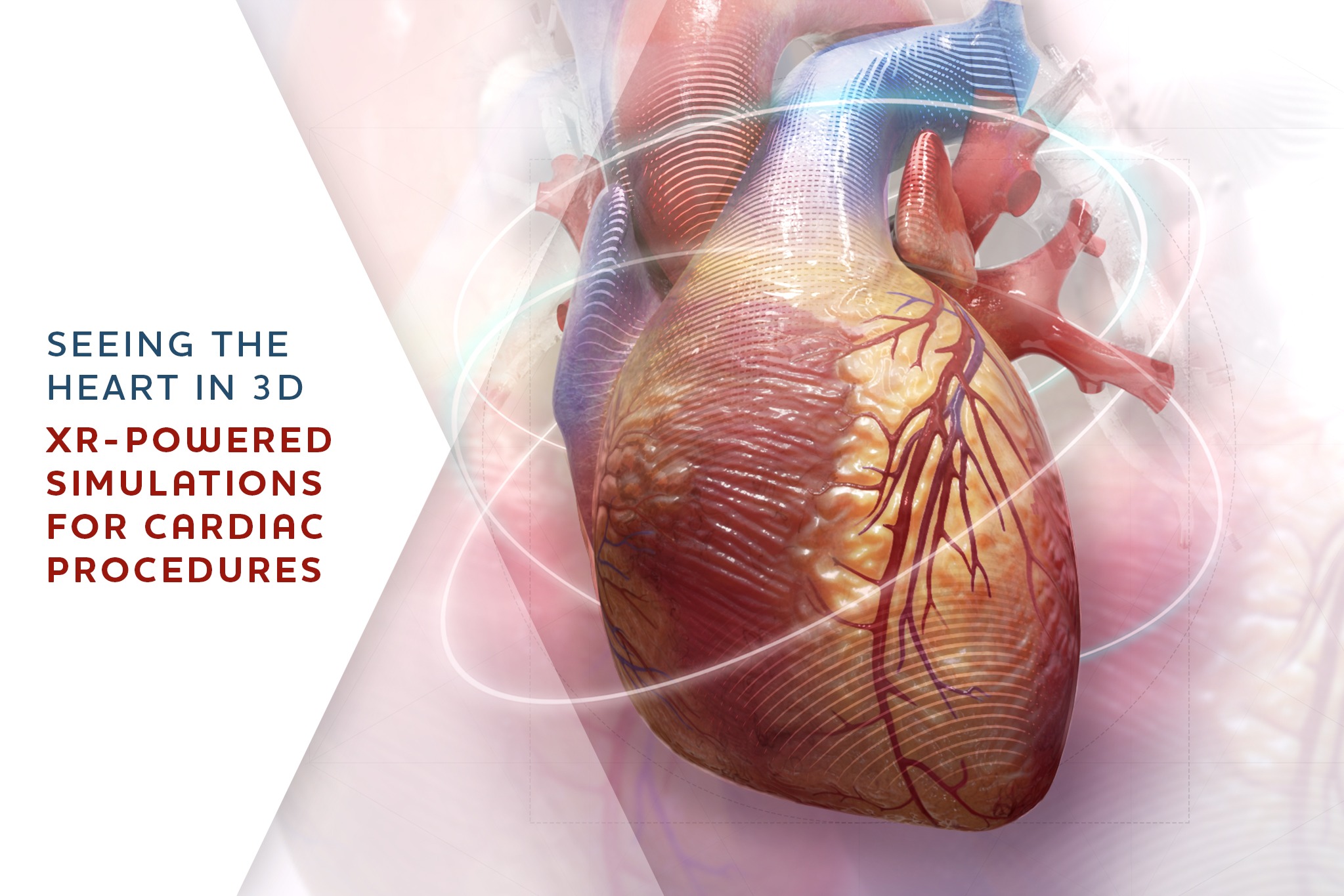
Cardiology training has entered a new era. Established educational approaches, including structured coursework and supervised hands-on experience, continue to form the foundation of clinical learning. Alongside these methods, recent advances in immersive technology have introduced eXtended Reality (XR)-powered simulations that bring realistic three-dimensional representations of the heart into the training environment. These platforms allow clinicians to visualize anatomy from multiple perspectives, rehearse procedures, and refine technical skills in a controlled, immersive setting. Evidence suggests that such experiential learning can strengthen spatial understanding, support procedural confidence, and enhance technical preparation before entering the cath lab or operating room. In this context, immersive simulations for complex cardiovascular procedures provide safe, controlled practice environments that reinforce spatial awareness and procedural planning.1
In healthcare training and experiential learning, eXtended Reality (XR) refers to a spectrum of technologies that blend virtual and physical environments, including Virtual Reality (VR), Augmented Reality (AR), and Mixed Reality (MR). VR creates fully immersive digital environments that replace the user’s real-world view with simulated content. AR overlays digital information onto the physical environment without full immersion. MR allows virtual objects to interact with the real world and the user’s environment in real time. The best part is that these XR formats can all be adapted to work on tablet computers, so special glasses or headsets are not required in order to engage in these types of training programs, and remote participation can also be made possible every time.
This technology is now being used across a range of practical healthcare applications, including structured clinical training, case planning, and the development of patient-specific anatomical models that help clinicians rehearse complex procedures in advance of real practice. In fact, 3D medical simulations are increasingly applied not only to clinician training but also to planning clinical cases and improving procedural confidence, illustrating how interactive visualization tools are extending beyond traditional instruction into broader aspects of healthcare preparation and execution.
Researchers have examined how these immersive, experiential learning environments can improve procedural planning, anatomical comprehension, and clinical training beyond conventional two-dimensional imaging systems and static models.2
Why Three-Dimensional Understanding Matters in Cardiology
Cardiac procedures, whether diagnostic or interventional, require a strong understanding of the spatial relationships within the heart. Imaging modalities such as echocardiography, computed tomography, and magnetic resonance provide detailed clinical information and are central to procedural planning. As trainees progress in their learning journey, developing an integrated three-dimensional mental model from these images becomes an important part of procedural learning. This is particularly relevant in areas such as catheter navigation and electrophysiological mapping, where spatial orientation plays a critical role in clinical decision-making and technical execution.
Enhancing spatial cognition is not a trivial benefit. Within experiential learning environments, eXtended Reality (XR) simulations allow users to explore cardiac anatomy from every angle, manipulate virtual instruments, and practice maneuvers that would otherwise be limited to cadaver labs or conventional simulators. This supports a clearer understanding of the orientation and relationships among cardiac chambers, valves, and vascular structures, which forms the foundation for safely performing catheter-based interventions, transseptal punctures, and device implantations; not to mention that it also can considerably lower monetary costs.
A systematic review indicates that immersive technologies can enhance comprehension of intricate anatomy by allowing clinicians to interact with three-dimensional representations that closely mimic physiological structures.3
Immersive Simulation in Action: XR in Cardiac Training
Virtual Reality (VR) applications are among the most studied within immersive cardiology training. Research on VR-based education in cardiology interventions has shown improved trainee performance, with positive effects on user engagement and technical skill acquisition.4 VR simulations allow trainees to practice procedures repeatedly without risk to patients, accelerating the development of procedural competence.
Augmented Reality (AR) and Mixed Reality (MR) further enhance the experiential learning environment. AR, for example, can overlay critical anatomical information directly into a trainee’s field of view, merging actual physical tools with digital guidance. A randomized controlled trial has shown that learning anatomy with three-dimensional virtual models significantly improves understanding and retention compared to two-dimensional resources.5
In addition, one systematic literature review highlighted that XR technologies are being explored across multiple stages of cardiac education and practice, from initial anatomy learning to procedural planning and even intra-procedural guidance. The review found several distinct XR systems described in the literature, each offering different approaches to immersive visualization, interaction, and user feedback.6
Simulating Catheter Navigation and Procedural Rehearsal
An area with particularly strong potential is immersive simulation of catheter-based navigation. Simulations that incorporate eXtended Reality (XR) allow trainees to practice threading catheters through three-dimensional reconstructions of patient-specific anatomy. Some research groups are experimenting with systems that integrate real-time tracking of interventional tools within immersive environments, enabling dynamic visualization of device movement during simulated procedures. This approach allows trainees to practice navigation and decision-making in a manner that more closely reflects the workflow of real cardiac interventions.
Patient-specific simulation has the potential to extend beyond generic models. Emerging research on dynamic digital-physical twins, which covers environments that integrate imaging data with real-time physiological motion, offers a more accurate training platform for coronary intervention planning and execution. These hybrid models combine virtual visualization with physical feedback, enhancing realism and procedural rehearsal.
By allowing clinicians to rehearse steps that would otherwise only be learned in high-stakes environments, eXtended Reality (XR)-powered simulations can reduce the cognitive load during real procedures. Familiarity with anatomy and procedural sequences gained through repeated simulation can translate to higher confidence, fewer hesitations, and reduced procedural errors.
Integration With Clinical Education and Workflow
In the context of structured clinical training programs, eXtended Reality (XR) offers benefits that extend beyond traditional instructional approaches. In fellowship and residency curricula, immersive simulation modules can supplement traditional education by offering interactive case scenarios, procedural walkthroughs, and performance feedback that align with educational goals. Some programs already integrate Virtual Reality (VR) and Augmented Reality (AR) content to reinforce theoretical learning with hands-on visual experience.
The authors of A New Educational Framework to Improve Lifelong Learning for Cardiologists study say, “While most simulation training in cardiology has been based on specific curricula, personalization of simulated scenarios is a potentially valuable pathway for lifelong learning. Based on the simulated performance of the learner as evaluated by both the simulator and instructors, layers of complexity can be added.”7
In addition to enhancing trainee experience, XR can support procedural planning for clinicians preparing for complex cases involving congenital or structural heart disease. Three-dimensional visualization tools help these clinicians interpret cross-sectional imaging and reconstruct the spatial relationships needed for safe device placement and intervention strategy planning.
Emerging Trends, Artificial Intelligence (AI), and Supporting Technologies
The impact of immersive simulation is amplified when combined with supporting technologies. Artificial Intelligence (AI) can enhance eXtended Reality (XR) platforms by providing performance analytics, objective feedback, and personalized learning pathways. AI-driven assessments can benchmark trainee performance against expert standards, highlight areas for improvement, and tailor simulation difficulty accordingly. A narrative review discusses how AI-driven adaptive systems paired with immersive VR environments can improve knowledge retention, provide real-time feedback, and enhance technical proficiency in clinical training contexts.8
Haptic feedback and realistic instrument interfaces further bridge the gap between virtual practice and real-world procedural skills. By simulating tactile responses during catheter manipulation or device deployment, these systems enrich the learning experience and better prepare clinicians for the physical aspects of interventions.
Considerations for Adoption and Future Development
As interest in experiential learning through immersive simulation continues to grow, ongoing research is helping to clarify how eXtended Reality (XR) can be most effectively integrated into cardiology training. While early studies demonstrate encouraging results, additional longitudinal research will further strengthen understanding of long-term clinical impact and procedural performance outcomes across diverse training contexts.
Implementation considerations also include infrastructure and resource planning. High-fidelity XR hardware, software development, and integration with clinical imaging systems necessitate meaningful investments. At the same time, continued advances in hardware accessibility and platform scalability are steadily lowering barriers to adoption, making experiential learning more feasible for a wider range of institutions.
User experience remains an important focus area as eXtended Reality (XR) technologies evolve. As clinicians become more familiar with immersive tools, structured onboarding, thoughtful instructional design, and ongoing technical support can help ensure comfort, usability, and sustained engagement. These efforts play a key role in maximizing the educational value of immersive simulations within clinical training programs.
A Complement to Traditional Methods
The goal of eXtended Reality (XR)-powered simulations is not to replace established training methods but to complement them. Traditional educational tools and hands-on experience remain foundational. Immersive simulations enhance these methods by providing interactive, repeatable, safe, and cost-effective environments where mistakes do not carry real-world consequences and complex spatial concepts can be explored intuitively.
Simulation-based learning has already gained broad acceptance in medical education, with centers worldwide using simulators to teach clinical reasoning, procedural skills, and team communication. XR extends this tradition by adding immersive, three-dimensional context that traditional simulators cannot provide.
Looking Forward to More Experiential Learning in Cardiac Care
The integration of immersive simulation into cardiology training heralds a future where clinicians build confidence and expertise through repeated, realistic practice. By combining Virtual Reality (VR), Augmented Reality (AR), Mixed Reality (MR), and eLearning with advanced imaging, data analytics, and adaptive feedback, training programs can better prepare practitioners for the demands of modern cardiac care. As evidence continues to accumulate and technology becomes more accessible, eXtended Reality (XR)-powered simulations may become a cornerstone of procedural education and experiential learning that elevates safety, proficiency, and patient outcomes.
While XR-powered simulations are not a wholesale replacement for conventional methods, they offer a compelling and evidence-backed enhancement that aligns with the evolving complexity and precision-oriented demands of any cardiovascular practice.
FAQs:
Q 1: What is eXtended Reality (XR) in cardiology training?
In cardiology training, eXtended Reality refers to immersive technologies that blend virtual and physical environments to support experiential learning. XR includes Virtual Reality (VR), which creates fully immersive simulations, Augmented Reality (AR), which overlays digital information onto the physical world, and Mixed Reality (MR), which enables interaction between virtual content and real environments. These technologies are used to support three-dimensional visualization, procedural rehearsal, and clinical preparation.
Q2: How do XR-powered simulations support experiential learning in cardiology?
XR-powered simulations support experiential learning by allowing clinicians to interact directly with three-dimensional cardiac anatomy, rehearse procedural steps, and practice catheter navigation in safe, controlled environments. These immersive experiences reinforce spatial understanding, procedural planning, and technical readiness before clinicians enter high-stakes settings such as the cath lab or operating room.
Q3: Why is three-dimensional visualization important for cardiac procedures?
Three-dimensional visualization is important in cardiology because many diagnostic and interventional procedures depend on accurate spatial understanding of cardiac chambers, valves, and vascular structures. Enhanced three-dimensional visualization supports orientation, navigation, and decision-making during catheter-based interventions, electrophysiological mapping, and device implantation.
Q4: Is XR intended to replace traditional cardiology training methods?
XR is not intended to replace traditional cardiology training methods. Established approaches, including structured coursework, imaging interpretation, and supervised hands-on experience, remain foundational. XR-powered simulations complement these methods by adding immersive, experiential learning environments that support procedural rehearsal, confidence-building, and skill refinement.
Q5: How are Artificial Intelligence (AI) and other technologies used with XR in cardiology training?
AI can enhance XR-based cardiology training by enabling performance analytics, adaptive feedback, and personalized learning pathways. When combined with immersive simulations, AI-driven systems can assess learner performance, identify areas for improvement, and adjust scenario complexity. Additional technologies, such as haptic feedback and realistic instrument interfaces, further support experiential learning by simulating procedural interactions.
References:
- Dominika Kanschik, Raphael Romano Bruno, Michel E van Genderen, Patrick W Serruys, Tsung-Ying Tsai, Malte Kelm, Christian Jung, Extended reality in cardiovascular care: a systematic review, European Heart Journal – Digital Health, Volume 6, Issue 5, September 2025, Pages 878–887, https://doi.org/10.1093/ehjdh/ztaf070
- Brachet, A., Biskupski, M., Hunek, G., Rusek, J., Bełżek, A., Forma, A., Teresiński, G., Sitarz, R., Karpiński, R., & Baj, J. (2025). Virtual Reality in Preclinical and Clinical Education—An Insight into Current Advancements and Future Perspectives. Applied Sciences, 15(24), 12941. https://doi.org/10.3390/app152412941
- Yuk Ming Tang, Ka Yin Chau, Alex Pak Ki Kwok, Tongcun Zhu, Xiangdong Ma, A systematic review of immersive technology applications for medical practice and education – Trends, application areas, recipients, teaching contents, evaluation methods, and performance, Educational Research Review, Volume 35, 2022, 100429, ISSN 1747-938X, https://doi.org/10.1016/j.edurev.2021.100429
- Aslani, N., Behmanesh, A., Garavand, A., Maleki, M., Davoodi, F., & Shams, R. (2022). The Virtual Reality Technology Effects and Features in Cardiology Interventions Training: A Scoping Review. Medical journal of the Islamic Republic of Iran, 36, 77. https://doi.org/10.47176/mjiri.36.77
- Hammouda, S.B., Maoua, M. & Bouchahma, M. The effectiveness of VR-based human anatomy simulation training for undergraduate medical students. BMC Med Educ 25, 816 (2025). https://doi.org/10.1186/s12909-025-07402-5
- Kanschik, D., Bruno, R. R., van Genderen, M. E., Serruys, P. W., Tsai, T. Y., Kelm, M., & Jung, C. (2025). Extended reality in cardiovascular care: a systematic review. European heart journal. Digital health, 6(5), 878–887. https://doi.org/10.1093/ehjdh/ztaf070
- Narang, A., Velagapudi, P., Rajagopalan, B., LeBude, B., Kithcart, A. P., Snipelisky, D., & Sinha, S. S. (2018). A New Educational Framework to Improve Lifelong Learning for Cardiologists. Journal of the American College of Cardiology, 71(4), 454–462. https://doi.org/10.1016/j.jacc.2017.11.045
- Chance, E.A. The combined impact of AI and VR on interdisciplinary learning and patient safety in healthcare education: a narrative review. BMC Med Educ 25, 1039 (2025). https://doi.org/10.1186/s12909-025-07589-7
![[Approved] Enhancing Cardiology Device Launches Through XR [2026]](https://tipmedia.com/wp-content/uploads/2026/02/blog_feb_2-3.jpg)