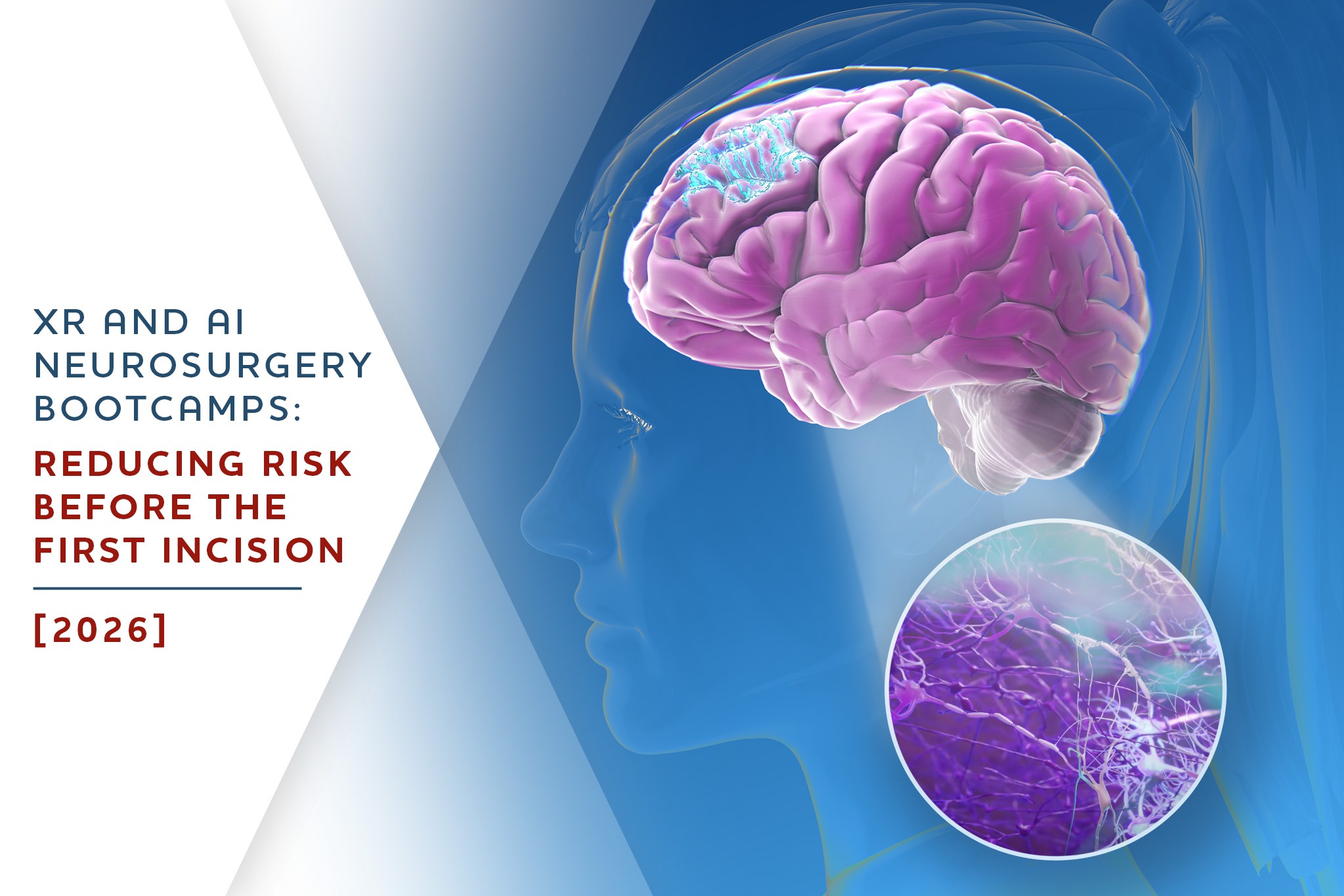
Neurosurgery represents one of the most technically demanding fields in modern medicine. Procedures such as intracranial tumor resections, cerebral aneurysm repairs, and skull base interventions require precise navigation through densely packed neural structures where millimeters determine functional outcomes. Even minor deviations can result in permanent neurological deficits, functional impairment, or life-threatening complications. Surgical competency, therefore, depends not only on theoretical knowledge but also on deeply internalized spatial understanding, refined motor skills, and procedural familiarity developed through extensive experience.
Traditional neurosurgical education has long relied on graduated operative exposure, cadaveric dissection, imaging review, and supervised participation in live procedures. These approaches remain essential components of neurosurgical training and continue to provide critical experiential foundations. However, increasing procedural complexity, variability in case exposure across training programs, and heightened patient safety expectations have highlighted the need for complementary training methods that allow procedural rehearsal before live surgical performance.
Experiential learning in neurosurgical training is increasingly supported by immersive technologies such as eXtended Reality (XR), which encompasses Virtual Reality (VR), Augmented Reality (AR), and Mixed Reality (MR), together with Artificial Intelligence (AI) as an enabling layer. These technologies together allow trainees to interact with patient-specific three-dimensional anatomical models derived from medical imaging. These environments allow rehearsal of complex procedures, visualization of critical neuroanatomical relationships, and refinement of surgical techniques in realistic, risk-free settings. Neurosurgical bootcamps built around XR and AI simulation provide structured, high-fidelity training experiences that enhance procedural preparedness while reducing reliance on first-time execution in the operating room.
Evidence from peer-reviewed research increasingly demonstrates that simulation-based neurosurgical training improves spatial understanding, procedural planning, learner confidence, and technical performance.1 These advances support safer surgical practice and more consistent competency development across training programs, ultimately reducing risk before the first incision.
Understanding XR and AI in Neurosurgery Training
Immersive technologies, collectively referred to as eXtended Reality (XR), encompass Virtual Reality (VR), Augmented Reality (AR), and Mixed Reality (MR). Each modality offers distinct capabilities relevant to neurosurgical education. VR creates fully immersive digital environments that allow learners to interact with anatomical structures and surgical tools in simulated operating rooms. AR overlays digital anatomical information onto physical environments, enhancing visualization during simulation or procedural rehearsal. MR integrates digital and physical elements in real time, allowing for interaction with holographic anatomical models anchored in a physical space.
The integration of Artificial Intelligence (AI) enhances the learning experience by enabling automated imaging segmentation, patient-specific anatomical modeling, performance analytics, and adaptive learning pathways. AI-driven platforms convert Computed Tomography (CT) and Magnetic Resonance Imaging (MRI) datasets into three-dimensional representations of tumors, vascular malformations, and adjacent neural structures, enabling precise procedural rehearsal.
Research has demonstrated that Virtual Reality (VR) based neurosurgical simulation significantly improves anatomical understanding and procedural planning compared with traditional two-dimensional imaging review.2 Improved spatial comprehension supports accurate surgical approach selection, enhances intraoperative orientation, and contributes to safer and more effective outcomes.
Neurosurgery Bootcamps as Structured Simulation-Based Training Programs
While immersive technologies provide the tools, structured bootcamp models provide the educational framework. These bootcamps provide controlled environments where residents and early-career neurosurgeons can rehearse procedures, refine technical skills, and strengthen anatomical understanding before live operative participation. Experiential learning, with immersive simulations and guided procedural walkthroughs, allows for repeated practice and progressive, hands-on skill development without patient risk.
Integration of eXtended Reality (XR), which encompasses Virtual Reality (VR), Augmented Reality (AR), and Mixed Reality (MR), along with Artificial Intelligence (AI), enables the creation of patient-specific anatomical models derived from medical imaging. These models enable procedural rehearsal that reflects real surgical scenarios, helping learners visualize anatomy, plan surgical approaches, and anticipate procedural challenges before entering the operating room. The following sections examine these key benefits and their impact on neurosurgical training and procedural preparedness.
Benefit 1: Improved Spatial Understanding of Complex Neuroanatomy
Spatial awareness represents one of the most critical competencies in neurosurgery. Brain structures exist in dense, three-dimensional configurations that require precise navigation during surgical procedures.
Immersive visualization enabled by experiential learning allows for exploration of neuroanatomy from multiple angles, providing deeper spatial comprehension. Virtual Reality (VR) and Mixed Reality (MR) environments give learners the power to manipulate anatomical structures, visualize tumor margins relative to critical neural pathways, and rehearse surgical trajectories.
Studies show that Virtual Reality (VR)-based simulations improve neurosurgical trainee spatial understanding and anatomical knowledge retention by enabling detailed visualization of complex three-dimensional neuroanatomical relationships.3 Improved spatial cognition supports more accurate anatomical interpretation and contributes to safer and more precise surgical execution.
Research also demonstrates that experiential learning through immersive simulation improves mental rehearsal and procedural anticipation by allowing learners to interact with complex anatomical structures and rehearse procedural steps in realistic environments.4 Enhanced cognitive preparedness supports more effective surgical planning and strengthens decision-making during complex procedures. This means fewer early-stage errors, greater trainee confidence, and improved surgical preparedness.
Benefit 2: Patient-Specific Procedural Rehearsal
High-fidelity neurosurgical bootcamps leverage eXtended Reality (XR) and Artificial Intelligence (AI) to create patient-specific procedural simulations derived directly from medical imaging datasets. AI algorithms segment critical anatomical structures, including tumors, vasculature, white matter tracts, and cranial nerves, producing precise three-dimensional digital models.
These simulation environments enable trainees to rehearse complex procedures, including:
- Intracranial tumor resections
- Cerebral aneurysm clippings
- Arteriovenous malformation treatments
- Skull base surgical approaches
- Minimally invasive spinal decompressions
Practice within these environments allows learners to visualize anatomical relationships, select optimal surgical approaches, and anticipate procedural challenges before performing live surgery.
Research demonstrates that patient-specific Virtual Reality (VR) simulation enables preparation for individual surgical procedures and improves procedural planning and skill development in neurosurgical training.5 Improved procedural preparation contributes to greater surgical accuracy, efficiency, and overall operative safety.
Further validation comes from studies published in surgical literature showing that simulation-based training improves operative performance and reduces procedural errors among surgical trainees.6 These findings demonstrate measurable improvements in surgical competency through simulation-based rehearsal and support safer surgical execution.
Benefit 3: Accelerated Skill Development Through Experiential Learning and Deliberate Practice
Neurosurgery bootcamps grounded in experiential learning principles provide intensive, focused training experiences. Experiential learning emphasizes active participation, immediate feedback, and iterative skill refinement. Simulation environments support deliberate practice, which involves repetitive performance of specific tasks combined with structured feedback.
Bootcamp models also create controlled exposure to rare or complex scenarios that trainees may not encounter frequently in clinical practice. Simulation of aneurysm rupture scenarios or complex skull base tumors prepares trainees for high-stakes situations.
Research shows that deliberate practice significantly improves clinical skill acquisition and procedural performance through repeated, structured rehearsal and feedback.7
Benefit 4: Improved Proficiency in Surgical Technologies and Procedural Workflows
Neurosurgical procedures frequently involve specialized technologies, including surgical navigation platforms, robotic assistance systems, neurostimulation devices, and advanced imaging technologies. Structured training on these systems is essential to ensure safe and effective clinical use.
Simulation-based bootcamps enable clinicians to learn device workflows, instrument handling, and procedural integration without patient risk. Immersive environments powered by eXtended Reality (XR) replicate device interfaces and procedural interactions, enabling hands-on experiential learning.
Collaboration between medtech companies and training institutions supports effective device education while maintaining educational integrity and clinical relevance. Effective device training contributes to improved clinical outcomes and safer technology adoption.
Research demonstrates that simulation-based device training improves device handling proficiency and procedural efficiency.8
Benefit 5: Objective Skill Assessment and Performance Analytics
Artificial Intelligence (AI) plays a critical role in performance assessment during neurosurgical bootcamps. AI-powered analytics evaluate procedural metrics, including instrument movement efficiency, tissue handling precision, procedural duration, and error rates.
Traditional assessment methods often rely on faculty evaluation, which may vary between instructors and institutions. Artificial Intelligence (AI)-driven assessment introduces objective, reproducible measurement of procedural competency. Objective performance metrics enable consistent, standardized evaluation across trainees and training programs, supporting competency-based progression and ensuring readiness before live procedures.
Research shows that AI–based surgical skill assessment can accurately differentiate between novice and expert surgeons by analyzing instrument motion patterns and procedural performance data.9
Benefit 6: Improved Learner Confidence, Satisfaction, and Preparedness
Learner confidence represents a critical factor in surgical performance. Neurosurgical procedures require decisive action under pressure, and uncertainty may increase procedural risk. Simulation-based bootcamps allow experiential learners to develop familiarity with procedural workflows before performing live surgery. Increased confidence contributes to improved surgical performance and reduced procedural stress, while simulation-based training strengthens knowledge retention and procedural preparedness.
Research shows that experiential learning improves learner satisfaction, confidence, and technical skill acquisition compared with traditional training alone.10
Additional insights on immersive simulation adoption across medtech education and surgical training appear in this analysis of immersive healthcare training trends, which highlights increasing integration of immersive simulation into clinical education ecosystems.
Benefit 7: Standardized Training Across Institutions
Variability in neurosurgical training exposure represents a significant educational challenge. Some institutions provide extensive exposure to complex tumor cases, while others may focus on vascular or spinal procedures. Experiential learning bootcamps that are simulation-based provide standardized exposure to essential procedures regardless of institutional case volume.
Standardized simulation curricula ensure consistent competency development across training programs. Objective assessment tools enable benchmarking and competency validation.
Studies have emphasized the importance of simulation in standardizing neurosurgical education and improving procedural competency.11 Consistent training standards contribute to improved patient safety and more predictable surgical outcomes.
Benefit 8: Reducing Risk Before the First Incision
Procedural risk reduction represents one of the most important benefits of simulation-based neurosurgical bootcamps. Surgical simulation allows learners to make mistakes, refine techniques, and improve procedural planning without patient harm or extraneous costs to well-established training institutions.
Patient-specific rehearsal improves surgical strategy development, allowing surgeons to anticipate anatomical challenges and optimize procedural approaches.
Evidence supports the role of simulation-based training in improving patient safety and reducing surgical complications.12
Future Directions in XR and AI Neurosurgical Education
Advances in eXtended Reality (XR), which encompasses Virtual Reality (VR), Augmented Reality (AR), and Mixed Reality (MR), are expected to enable increasingly realistic, interactive neurosurgical simulations. Improvements in visualization, haptics, and real-time anatomical interaction are expected to allow fully immersive rehearsal of complex and high-risk procedures.
Artificial Intelligence (AI) is expected to enable automated generation of patient-specific simulations, real-time performance feedback, and adaptive training pathways. Together, XR and AI may allow neurosurgery bootcamps to deliver more personalized, scalable, and standardized training, further strengthening procedural preparedness and reducing risk before live surgical intervention.
Conclusion
Neurosurgery bootcamps that integrate eXtended Reality (XR) and Artificial Intelligence (AI) technologies are reshaping how procedural readiness is developed and assessed. These structured simulation environments enable standardized, scalable training that aligns skill development with objective competency benchmarks.
Continued adoption of XR and AI simulation platforms is expected to play an increasingly important role in neurosurgical education, supporting consistent skill development, standardized competency validation, and improved patient safety from the first surgical incision to the last.
FAQS:
Q1. What are XR and AI neurosurgery bootcamps?
Neurosurgery bootcamps are structured simulation programs that integrate eXtended Reality (XR), which encompasses Virtual Reality (VR), Augmented Reality (AR), and Mixed Reality (MR), along with Artificial Intelligence (AI), into experiential learning programs for higher learning potential and retention. These programs are designed to improve surgical readiness and procedural competency. They create immersive, patient-specific training environments that allow trainees to rehearse complex procedures, receive objective performance feedback, and refine technical skills before participating in live surgical cases.
Q2. How does XR improve neurosurgery training?
Immersive simulations powered by eXtended Reality (XR) improve neurosurgery training by enabling three-dimensional visualization of complex neuroanatomy and procedural workflows. XR-based environments allow trainees to explore anatomical structures from multiple angles, rehearse surgical approaches, and practice procedural steps in realistic settings. These capabilities strengthen spatial understanding, enhance procedural planning, and support overall surgical preparedness.
Q3. How do XR and AI work together in neurosurgical bootcamps?
In neurosurgical bootcamps, eXtended Reality (XR) provides immersive, three-dimensional simulation environments, while Artificial Intelligence (AI) supports model generation and performance analysis. AI assists with patient-specific case preparation and objective skill evaluation, strengthening the educational impact of XR-based simulations.
Q4. Do neurosurgery bootcamps reduce surgical risk?
Simulation-based neurosurgical training improves procedural planning, technical performance, and decision-making. By allowing trainees to rehearse procedures and refine techniques before entering the operating room, neurosurgery bootcamps reduce reliance on first-time execution in live cases. This structured preparation supports improved surgical safety and reduced procedural risk.
Q5. Why are patient-specific simulations important in neurosurgery training?
Patient-specific simulations allow neurosurgeons to rehearse procedures using three-dimensional models derived from real medical imaging data. This approach reflects the anatomical variations and procedural challenges of individual cases. Patient-specific rehearsal improves surgical strategy development, enhances spatial comprehension, and supports more precise intraoperative decision-making.
REFERENCES:
- Davids, J., Manivannan, S., Darzi, A., Giannarou, S., Ashrafian, H., & Marcus, H. J. (2021). Simulation for skills training in neurosurgery: a systematic review, meta-analysis, and analysis of progressive scholarly acceptance. Neurosurgical review, 44(4), 1853–1867. https://doi.org/10.1007/s10143-020-01378-0
- Kin, T., Nakatomi, H., Shono, N., Nomura, S., Saito, T., Oyama, H., & Saito, N. (2017). Neurosurgical Virtual Reality Simulation for Brain Tumor Using High-definition Computer Graphics: A Review of the Literature. Neurologia medico-chirurgica, 57(10), 513–520. https://doi.org/10.2176/nmc.ra.2016-0320
- Kin, T., Nakatomi, H., Shono, N., Nomura, S., Saito, T., Oyama, H., & Saito, N. (2017). Neurosurgical Virtual Reality Simulation for Brain Tumor Using High-definition Computer Graphics: A Review of the Literature. Neurologia medico-chirurgica, 57(10), 513–520. https://doi.org/10.2176/nmc.ra.2016-0320
- Lan, L., Mao, R. Q., Qiu, R. Y., Kay, J., & de Sa, D. (2023). Immersive Virtual Reality for Patient-Specific Preoperative Planning: A Systematic Review. Surgical innovation, 30(1), 109–122. https://doi.org/10.1177/15533506221143235
- Greuter, L., De Rosa, A., Cattin, P., Croci, D. M., Soleman, J., & Guzman, R. (2021). Randomized study comparing 3D virtual reality and conventional 2D on-screen teaching of cerebrovascular anatomy. Neurosurgical Focus, 51(2), E18. https://doi.org/10.3171/2021.5.FOCUS21212
- Vanderbilt, A. A., Grover, A. C., Pastis, N. J., Feldman, M., Granados, D. D., Murithi, L. K., & Mainous, A. G., 3rd (2014). Randomized controlled trials: a systematic review of laparoscopic surgery and simulation-based training. Global journal of health science, 7(2), 310–327. https://doi.org/10.5539/gjhs.v7n2p310
- McGaghie, W. C., Issenberg, S. B., Cohen, E. R., Barsuk, J. H., & Wayne, D. B. (2011). Does simulation-based medical education with deliberate practice yield better results than traditional clinical education? A meta-analytic comparative review of the evidence. Academic medicine : journal of the Association of American Medical Colleges, 86(6), 706–711. https://doi.org/10.1097/ACM.0b013e318217e119
- Shahrezaei, A., Sohani, M., Taherkhani, S. et al. The impact of surgical simulation and training technologies on general surgery education. BMC Med Educ 24, 1297 (2024). https://doi.org/10.1186/s12909-024-06299-w
- Uemura, M., Tomikawa, M., Miao, T., Souzaki, R., Ieiri, S., Akahoshi, T., Lefor, A. K., & Hashizume, M. (2018). Feasibility of an AI-Based Measure of the Hand Motions of Expert and Novice Surgeons. Computational and mathematical methods in medicine, 2018, 9873273. https://doi.org/10.1155/2018/9873273
- Agha, S., Alhamrani, A. Y., & Khan, M. A. (2015). Satisfaction of medical students with simulation based learning. Saudi medical journal, 36(6), 731–736. https://doi.org/10.15537/smj.2015.6.11501
- Harrop, James MD*; Lobel, Darlene A. MD‡; Bendok, Bernard MD§; Sharan, Ashwini MD*; Rezai, Ali R. MD¶. Developing a Neurosurgical Simulation-Based Educational Curriculum: An Overview. Neurosurgery 73():p S25-S29, October 2013. https://journals.lww.com/neurosurgery/abstract/2013/10001/developing_a_neurosurgical_simulation_based.7.aspx
- Mileder, L. P., & Schmölzer, G. M. (2016). Simulation-based training: the missing link to lastingly improved patient safety and health?. Postgraduate Medical Journal, 92(1088), 309-311. https://academic.oup.com/pmj/article-abstract/92/1088/309/6984287
![[Approved] Enhancing Cardiology Device Launches Through XR [2026]](https://tipmedia.com/wp-content/uploads/2026/02/blog_feb_2-3.jpg)