Aseptic processing is the cornerstone of sterile pharmaceutical and biotech manufacturing, where even minor deviations can compromise product safety. Unlike terminal sterilization, aseptic operations depend on the consistent control of environmental conditions, equipment, and, most critically, human behavior.
Regulatory expectations have shifted toward demonstrable performance in real operating conditions. Training approaches that focus primarily on documentation (read) and procedural acknowledgment (attest) are no longer considered an acceptable training.
Within this landscape, contamination risk is not evenly distributed. Human intervention remains one of the most significant contributors to microbial and particulate contamination. Activities such as gowning, aseptic manipulations, and in-process interventions introduce variability that directly affects cleanroom performance.
Research demonstrates that operator behavior is a primary driver of contamination events in cleanroom environments.1
The Evolving Expectations for Aseptic Processing Training
Regulatory guidance now defines training as a core element of the contamination control strategy, with clear expectations for how personnel capability is developed and assessed.
Guidance such as Annex 1 of EU GMP and recommendations from the U.S. Food and Drug Administration (FDA) emphasize that training must prepare personnel to perform consistently under both routine and non-routine conditions.
Inspectors focus on whether personnel can:
- Perform aseptic interventions without disrupting unidirectional airflow
- Maintain sterile technique during extended operations
- Execute gowning procedures without introducing contamination risk
- Respond appropriately to deviations and unexpected events
In addition, training programs are expected to incorporate ongoing qualification, not just initial certification. Periodic reassessment must reflect actual job conditions, including complexity, variability, and time pressure.
Regulatory feedback has also clarified the limitations of passive training models. Completion records and procedural acknowledgment do not provide sufficient evidence of readiness. Training must generate observable outcomes that demonstrate consistency and control in practice.
The European Medicines Agency further emphasizes the need to align personnel qualification with real operational demands, ensuring that training reflects the conditions under which aseptic processing occurs.
This shift establishes a more defined standard: training must translate directly into reliable performance on the manufacturing floor, with clear linkage to contamination control objectives.
Simulation-Based Training in Aseptic Processing
In this context, simulation refers to structured, scenario-based experiential learning environments that replicate cleanroom operations, including:
- Gowning procedures
- Aseptic interventions
- Risk Management
- Personnel and environmental monitoring
- Contamination response scenarios
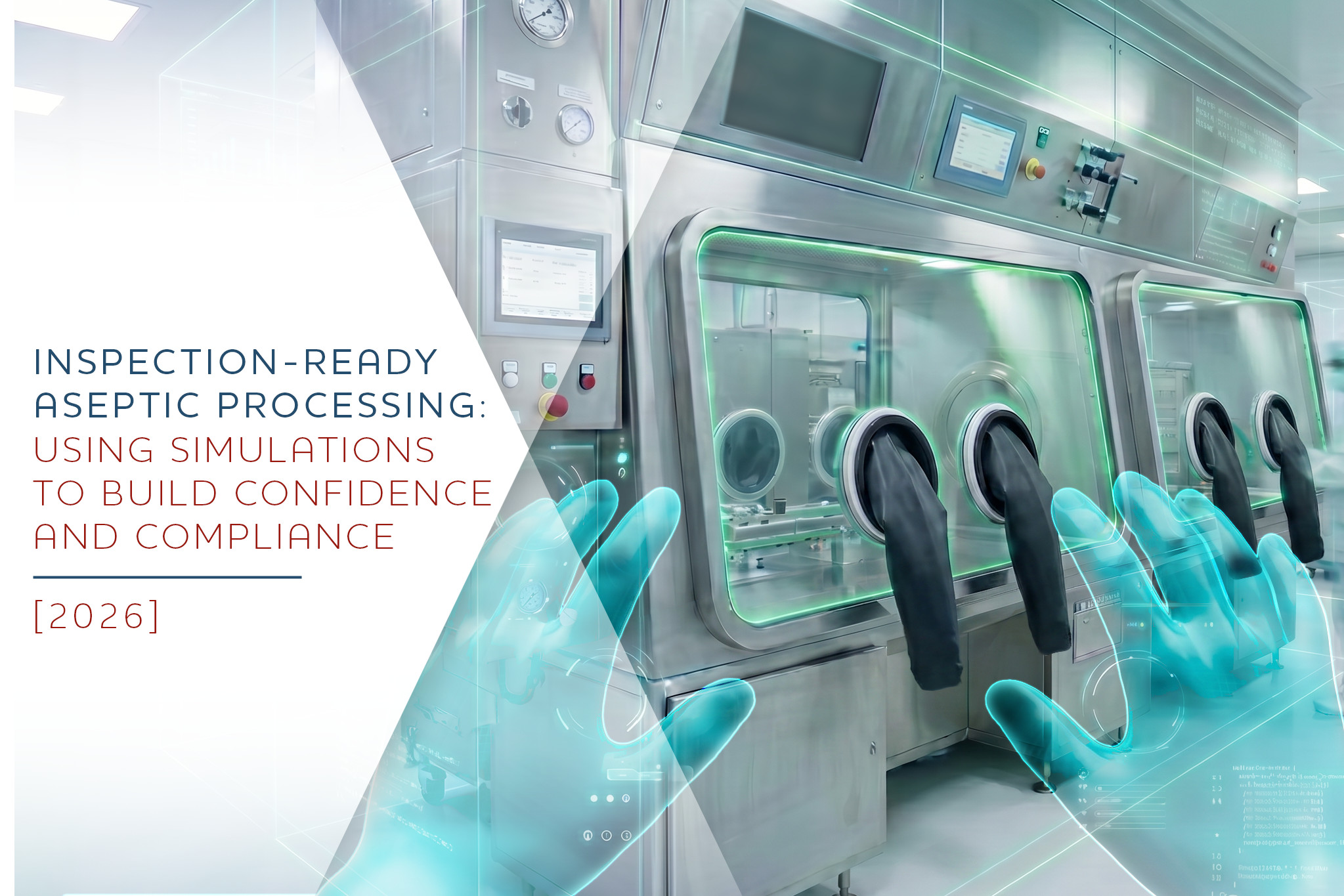
These simulations may be delivered through digital platforms, including eXtended Reality (XR), which comprises Virtual Reality (VR), Augmented Reality (AR), and Mixed Reality (MR). In training environments, XR enables immersive interaction with virtual cleanroom environments, allowing personnel to perform tasks, make decisions, and observe outcomes in real time.
A growing body of evidence supports the effectiveness of simulation-based experiential learning in healthcare and pharmaceutical contexts. Research highlights that simulation improves skill retention, decision-making, and performance under pressure.2 Similar findings have been reported in pharmaceutical training environments, where experiential learning enhances procedural adherence and reduces variability.
How Simulation-Based Training Drives Inspection Readiness
Simulation-based training delivers value across multiple dimensions of aseptic processing, with each benefit reinforcing the ability of personnel to perform consistently under inspection conditions.
At the core of this impact is inspection readiness. Inspectors assess whether personnel can execute procedures reliably, respond to variability, and maintain control under pressure.
Simulation-based training strengthens inspection readiness through:
- Demonstrable competency: Performance within simulations can be tracked and recorded, providing objective evidence of skill and consistency
- Scenario-based preparation: Personnel can practice interventions, deviations, and edge cases that mirror inspection focus areas
- Behavioral alignment: Training reinforces contamination control behaviors expected under regulatory scrutiny
Guidance from the European Medicines Agency and the U.S. Food and Drug Administration (FDA) emphasizes that qualification must reflect actual performance, and not just theoretical understanding. Simulation-based training supports this by enabling repeated, consistent practice of precise aseptic techniques, helping personnel develop the control and discipline required in cleanroom environments without the risks, material costs, or constraints of live operations.
These outcomes are enabled by a set of capabilities developed through simulation-based training. The following sections outline how these capabilities translate into consistent performance in aseptic environments.
Capability 1: Building Muscle Memory Through Repetition
Aseptic processing demands precision and consistency. Tasks such as aseptic cleaning processes, sterile gowning, or interventions within laminar airflow zones involve sequences of actions that must be executed without errors or deviation.
Simulation enables repeated practice without the constraints of production schedules or material costs. Personnel can rehearse:
- Correct gowning techniques, including sequencing and contamination avoidance
- Proper hand movements within critical zones
- Proper aseptic cleaning techniques including direction, sequence and overlaps
- Response protocols during interventions
Repetition in simulated environments builds muscle memory, which is essential for consistent execution during live operations. Research indicates that repeated, context-specific practice significantly improves procedural accuracy and reduces error rates.3
In aseptic environments, this translates to fewer deviations and stronger adherence to contamination control strategies.
Capability 2: Enhancing Contamination Control Awareness
Contamination control strategies require more than procedural knowledge. Personnel must understand how actions influence airflow, particle movement, and microbial risk.
Simulation environments can visualize otherwise invisible factors, such as:
- Airflow disruption caused by improper movement
- Particle dispersion during interventions
- Cleaning direction, swipes, and overlaps
- Impact of improper glove contact with critical surfaces
This level of feedback is difficult to achieve in traditional training settings. By making consequences visible, simulations strengthen conceptual understanding and reinforce correct behaviors.
Research highlights the importance of visualizing consequences to improve operator behavior.4 Simulation-based approaches operationalize this insight, translating theory into actionable practice.
Capability 3: Reinforcing Data Integrity Behaviors
Data integrity remains a critical focus during inspections. Errors in documentation, incomplete records, or inconsistent practices can lead to significant findings.
Simulation-based training can incorporate data integrity scenarios, requiring personnel to:
- Record observations accurately
- Respond to discrepancies
- Follow ALCOA+ principles (Attributable, Legible, Contemporaneous, Original, Accurate, plus completeness, consistency, and durability)
By embedding these requirements within realistic workflows, training reinforces correct behaviors in context rather than in isolation.
Research from the World Health Organization on data integrity emphasizes the importance of practical training in preventing documentation errors.
Capability 4: Reducing Operational Constraints
Traditional hands-on training in cleanrooms presents logistical challenges:
- Production downtime
- Material and PPE consumption and waste
- Risk of contamination during training exercises
Simulation eliminates these constraints. Training can be conducted without interrupting operations or risking product quality. Personnel can practice rare or high-risk scenarios that would be impractical to replicate in a live environment.
This flexibility enables organizations to increase both the frequency and depth of training, supporting continuous improvement and sustained inspection readiness.
Integrating Simulation into a Broader Training Strategy
Simulations are most effective when integrated into existing training frameworks rather than replacing them entirely. A balanced approach may include:
- Foundational knowledge through SOPs and classroom instruction
- Simulation-based practice for skill development
- On-the-job qualification and periodic requalification
This layered approach aligns with adult learning principles and regulatory expectations for comprehensive training systems.
Industry discussions on training effectiveness increasingly emphasize the need to move beyond passive instruction toward experiential models that reflect real-world complexity. Simulation-based experiential learning and training represent a practical way to apply this approach within aseptic processing.
Addressing the Shift from “Read and Attest” to Applied Learning
Across aseptic processing environments, a clear pattern has emerged. Training approaches that rely on “read and attest” confirm exposure to procedures, but do not demonstrate the ability to execute them under real operating conditions.
This gap directly affects inspection readiness. Expectations now center on consistent performance, appropriate response to variability, and sustained contamination control in practice.
For Good Practice (GxP) training leaders, this reflects a more defined expectation. Training systems must ensure that personnel can apply procedures reliably, not just acknowledge them.
Simulation-based experiential learning and training addresses this gap by enabling active participation, decision-making, and repeated execution of critical tasks in realistic scenarios. This aligns with the broader shift in learning and development toward measurable outcomes and observable behavior.
Future Directions: XR and the Expansion of Immersive Training
As digital technologies continue to advance, the role of eXtended Reality (XR), including Virtual Reality (VR), Augmented Reality (AR), and Mixed Reality (MR), is expected to expand within pharmaceutical training.
XR-based simulations offer several advantages:
- High fidelity replication of cleanroom environments
- Interactive, hands-on learning experiences
- Scalable deployment across global teams
Research in immersive, experiential learning indicates that XR improves engagement, retention, and skill transfer compared to traditional methods.5
Within aseptic processing, XR enables consistent training experiences across sites, supporting standardization and compliance.
Conclusion
Inspection readiness in aseptic processing depends on the alignment between knowledge, behavior, and regulatory expectations. Training systems must demonstrate that personnel can perform critical tasks consistently, manage contamination risks, and uphold data integrity.
Simulation-based experiential learning and training provides a structured, evidence-based approach to achieving these outcomes. By enabling realistic practice, reinforcing correct behaviors, and generating measurable performance data, simulations strengthen both individual competency and organizational compliance, while minimizing costs and risks to personnel, product, and operations..
For training leaders in GMP, GxP, and related domains, the shift toward experiential learning reflects a broader evolution in how capability is defined and assessed. The focus is moving toward demonstrated performance in context, supported by technologies that make such performance measurable and scalable.
In this environment, simulation is not a supplementary tool. It functions as a central component of a modern training strategy, aligned with the demands of aseptic processing and the expectations of regulatory inspection.
FAQs:
Q1. What is aseptic processing training and why is it important?
Aseptic processing training prepares personnel to perform sterile manufacturing tasks without introducing contamination. It is critical because aseptic operations rely heavily on human behavior, and even minor errors in gowning, interventions, or handling can compromise product safety and lead to regulatory findings.
Q2. How does simulation-based training improve inspection readiness in pharmaceutical manufacturing?
Simulation-based training improves inspection readiness by enabling personnel to practice real-world scenarios, demonstrate consistent performance, and respond effectively to deviations. It provides objective evidence of competency and aligns training outcomes with regulatory expectations for contamination control and human factors.
Q3. What are the limitations of “read and attest” training in aseptic environments?
“Read and attest” training confirms that personnel have reviewed procedures, but it does not demonstrate the ability to apply them in practice. Regulatory agencies have indicated that this approach is insufficient for aseptic processing, where consistent execution and decision-making under real conditions are essential.
Q4. How do cleanroom simulations support contamination control strategies?
Cleanroom simulations support contamination control by allowing personnel to visualize airflow disruption, particle movement, and contamination risks during interventions. This helps reinforce correct behaviors, improve situational awareness, and reduce variability in aseptic techniques.
Q5. What role does eXtended Reality (XR) play in aseptic processing training?
In aseptic processing training, eXtended Reality (XR), which includes Virtual Reality (VR), Augmented Reality (AR), and Mixed Reality (MR), enables immersive, scenario-based training in virtual cleanroom environments. XR allows personnel to practice critical tasks repeatedly, build muscle memory, and develop the precision required for aseptic operations without impacting production.
References:
- Smith, L. M., O’Driscoll, N. H., & Lamb, A. J. (2021). A comparison of the bacterial contamination of the surface of cleanroom operators’ garments following donning with and without gloves. Eur J Parenter Pharm Sci, 263. https://www.ejpps.online/post/vol26-3-a-comparison-of-the-bacterial-contamination-of-the-surface-of-cleanroom-operators-garments
- Garnier, A., Vanherp, R., Bonnabry, P., & Bouchoud, L. (2023). Use of simulation for education in hospital pharmaceutical technologies: a systematic review. European journal of hospital pharmacy : science and practice, 30(2), 70–76. https://doi.org/10.1136/ejhpharm-2021-003034
- Ruitenberg, M. F., De Kleine, E., Van der Lubbe, R. H., Verwey, W. B., & Abrahamse, E. L. (2012). Context-dependent motor skill and the role of practice. Psychological research, 76(6), 812–820. https://doi.org/10.1007/s00426-011-0388-6
- Garnier, A., Butaye, L., Bonnabry, P., & Bouchoud, L. (2023). A room of errors simulation to improve pharmacy operators’ knowledge of cytotoxic drug production. Journal of Oncology Pharmacy Practice, 29(8), 1868-1877. https://journals.sagepub.com/doi/10.1177/10781552231152145
- Thulasimani, S., Abhinayashree, T. N., Harisukumar, M., Aarthi, G., & Arulkumar, R. (2025, November). AR/VR-Enabled Workforce Training and Marketing Strategy in the Drug Manufacturing Industry. In 2025 International Conference on Digital Innovations for Sustainable Solutions (ICDISS) (pp. 1-6). IEEE. https://ieeexplore.ieee.org/abstract/document/11320595
![SOPs to Skills: Mastering GxP Through a Virtual Digital Twin of the Manufacturing Floor [2026]](https://tipmedia.com/wp-content/uploads/2026/04/April-2026-Blog-SOPs-to-Skills-Mastering-GxP.jpg)